Artificial Intelligence (AI) is reshaping the business landscape, offering opportunities for data-driven decision-making, operational efficiency, and innovation. However, diving into AI without assessing organizational readiness can lead to costly failures.
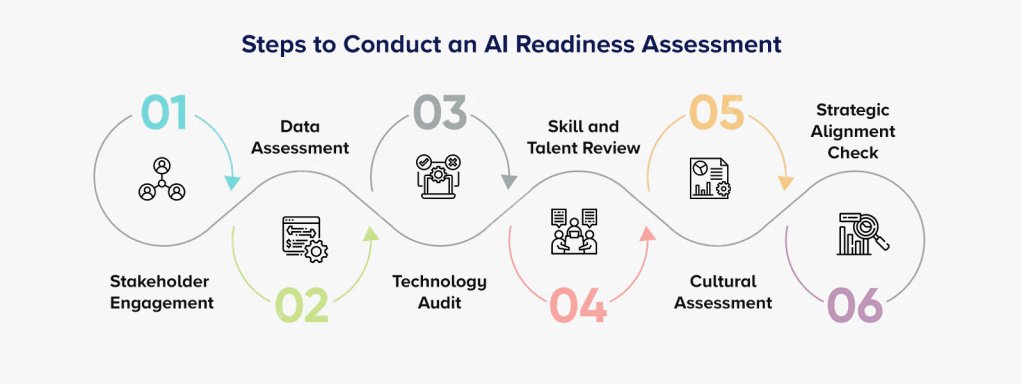
In this comprehensive guide, we break down six essential steps for conducting an AI readiness assessment to ensure your business is well-prepared for AI adoption and long-term success.
Why AI Readiness Matters
The AI landscape is competitive and dynamic. Companies that strategically prepare for AI adoption are more likely to achieve higher ROI, minimize risks, and stay ahead of industry trends.
Key Benefits of AI Readiness
- Faster time-to-market for AI applications
- Mitigated risks during AI deployment
- Improved stakeholder engagement and smoother adoption
- Enhanced data-driven decision-making
Step 1: Engage Stakeholders for AI Success
Why Stakeholder Engagement is Crucial:
AI initiatives thrive when stakeholders across departments contribute their insights and align toward common goals.
Actionable Steps
- Identify Key Stakeholders: Include leadership, data experts, and department heads.
- Define Roles and Responsibilities: Clarify who does what during AI implementation.
- Organize Collaborative Workshops: Gather inputs on pain points and AI possibilities.
💡 Pro Tip: Maintain open communication to address concerns and promote transparency.
Step 2: Conduct a Comprehensive Data Assessment
Why Data is the Lifeblood of AI:
AI models require large volumes of clean, structured, and accessible data to deliver accurate results.
Steps for a Robust Data Assessment
- Inventory Existing Data: Map out data sources from CRM, sales, and operations.
- Check Data Quality: Address issues such as duplicates and missing entries.
- Ensure Data Accessibility: Implement secure yet seamless data-sharing mechanisms.
- Establish Data Governance: Set up compliance frameworks for secure data management.
💡 Pro Tip: Use automated tools for real-time data cleansing and integration.
Step 3: Perform a Technology Audit
Why Evaluate Your Tech Infrastructure:
A strong technology backbone is essential to support AI workloads and real-time analytics.
Steps for an Effective Tech Audit
- Hardware & Software Review: Ensure compatibility with AI frameworks.
- Cloud Readiness: Consider cloud-based platforms for scalability.
- Identify Gaps: List upgrades required for AI deployment.
💡 Recommended Tools: TensorFlow, PyTorch, and scalable cloud services like AWS and Google Cloud.
Step 4: Review Skills and Talent Availability
Why AI Success Depends on People:
Your workforce needs both technical and domain-specific expertise to successfully implement AI.
Steps to Address Skill Gaps
- Inventory Skills: Map existing talent in AI, data analytics, and software engineering.
- Gap Analysis: Identify missing skills critical for AI execution.
- Upskilling Programs: Partner with training providers to bridge knowledge gaps.
- Hire AI Specialists: Onboard experts in machine learning and data science.
💡 Pro Tip: Build internal AI champions to foster a learning culture.
Step 5: Assess Cultural Readiness for AI Adoption
Why Culture Matters:
A culture resistant to change can stall AI initiatives. Building a data-driven mindset accelerates adoption.
Steps to Conduct a Cultural Assessment
- Gauge Openness to Change: Conduct surveys and interviews to understand employee sentiment.
- Evaluate Collaboration Levels: Ensure teams work across silos for AI projects.
- Build Trust in AI: Conduct AI awareness sessions to alleviate fears.
💡 Pro Tip: Recognize and celebrate AI-driven successes.
Step 6: Ensure Strategic Alignment with Business Goals
Why AI Must Align with Business Strategy:
AI initiatives should directly contribute to organizational objectives to justify investment.
How to Align AI with Business Strategy
- Set AI Objectives: Define specific, measurable goals for AI adoption.
- Prioritize Projects: Focus on areas with the highest impact potential.
- Monitor Performance: Track KPIs such as efficiency gains and customer engagement.
💡 Example Use Cases: AI for predictive maintenance, fraud detection, and customer analytics.
Bonus Tips for AI Readiness Assessment Success
- Start Small: Begin with a pilot AI project before scaling across departments.
- Continuous Monitoring: Regularly reassess AI readiness as technologies evolve.
- Collaborate with Experts: Seek AI consultants for tailored assessments.
Conclusion: Prepare Today for AI Success Tomorrow
Conducting a comprehensive AI readiness assessment is essential for laying a strong foundation for AI adoption. By following these six steps, organizations can identify gaps, allocate resources efficiently, and achieve seamless AI implementation.
Ready to start your AI journey? Follow this guide to future-proof your business and gain a competitive edge.


 B'yondAI
Leave a comment