The Record-to-Report (R2R) process plays a pivotal role in financial management, ensuring accurate data collection, reconciliation, financial close, and compliance reporting. Traditionally, these processes have been manual, time-consuming, and error-prone. However, the integration of Artificial Intelligence (AI) is revolutionizing R2R by automating critical tasks, enhancing data accuracy, and improving financial decision-making.
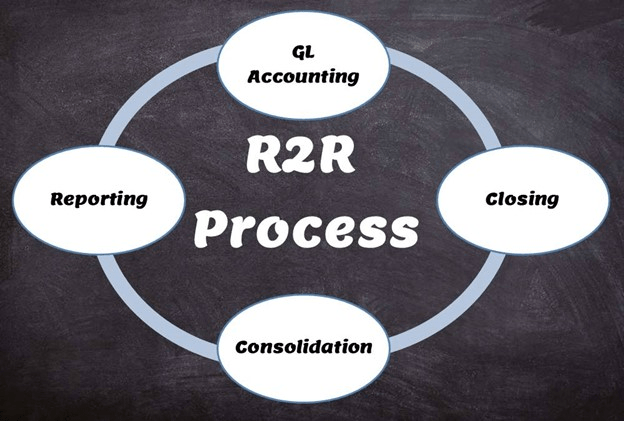
This article explores the various applications of AI in the R2R process, highlighting how AI-driven solutions optimize financial operations and drive efficiency in modern enterprises.
Key Applications of AI in Record-to-Report
1. Automated Data Collection & Processing
AI enables seamless extraction and processing of financial data from multiple sources, reducing the reliance on manual entry and eliminating errors. By leveraging AI-powered Optical Character Recognition (OCR) and Natural Language Processing (NLP), organizations can:
- Capture and validate financial data from invoices, receipts, and reports.
- Streamline journal entries and ledger updates.
- Minimize data inconsistencies and ensure real-time data availability.
2. Intelligent Reconciliation
One of the most time-consuming tasks in R2R is account reconciliation. AI-driven reconciliation tools:
- Automate the matching of transactions across multiple accounts.
- Identify anomalies and discrepancies in financial records.
- Provide recommendations for resolving mismatches, reducing manual intervention.
3. AI-Powered Financial Close Automation
The financial close process involves multiple stakeholders, approvals, and data verifications. AI accelerates closing cycles by:
- Automating recurring journal entries and adjustments.
- Predicting potential bottlenecks in the closing process.
- Enabling real-time tracking of closing activities through AI-driven dashboards.
4. Enhanced Financial Reporting & Compliance
Regulatory compliance and accurate financial reporting are crucial for organizations. AI improves reporting by:
- Generating automated financial statements using NLP-driven reporting tools.
- Ensuring compliance with regulatory standards such as IFRS, GAAP, and SOX.
- Detecting anomalies in financial statements to prevent compliance risks.
5. Predictive Analytics for Financial Forecasting
AI empowers finance teams with predictive analytics to forecast revenue, cash flow, and financial risks. With machine learning algorithms, organizations can:
- Identify patterns in historical financial data to predict future trends.
- Assess potential financial risks and take preventive actions.
- Optimize budget planning and resource allocation.
6. Fraud Detection & Risk Management
AI-driven fraud detection systems play a crucial role in identifying suspicious transactions and mitigating risks. These systems:
- Analyze transaction patterns to detect fraudulent activities.
- Flag anomalies in financial records that indicate potential fraud.
- Enhance internal controls by continuously monitoring financial transactions.
7. AI-Driven Decision Support Systems
CFOs and finance leaders rely on AI-powered insights to make data-driven decisions. AI assists in:
- Providing real-time financial analytics through AI dashboards.
- Recommending strategic financial actions based on market trends.
- Enhancing collaboration between finance teams with AI-driven chatbots and virtual assistants.
8. AI & Blockchain for Financial Transparency
Integrating AI with blockchain technology enhances financial transparency and auditability. Key benefits include:
- Secure and immutable financial transactions.
- Automated smart contracts for financial agreements.
- Reduced risk of financial data manipulation and fraud.
9. Hyper-Automation in R2R
AI, combined with Robotic Process Automation (RPA), drives hyper-automation in R2R by:
- Eliminating repetitive manual tasks.
- Enabling end-to-end process automation.
- Improving operational efficiency and cost savings.
10. ESG Reporting & Sustainability Compliance
Environmental, Social, and Governance (ESG) reporting is gaining importance in corporate finance. AI assists in ESG reporting by:
- Analyzing sustainability data for compliance.
- Automating ESG-related disclosures and reports.
- Monitoring carbon footprint and ethical financial practices.
Benefits of AI in Record-to-Report
1. Increased Accuracy & Reduced Errors
AI eliminates human errors in data entry, reconciliation, and reporting, ensuring greater accuracy in financial records.
2. Faster Financial Close & Reporting
By automating key R2R tasks, AI accelerates the financial close process, reducing month-end and year-end closing times.
3. Cost Efficiency
AI-driven automation reduces the need for manual intervention, leading to significant cost savings for enterprises.
4. Improved Decision-Making
AI-driven insights and predictive analytics enable finance teams to make proactive and data-driven decisions.
5. Enhanced Compliance & Risk Mitigation
AI ensures adherence to regulatory standards and minimizes compliance risks by detecting financial irregularities.
Challenges in AI Implementation for R2R
1. Integration Complexity
Integrating AI with existing financial systems requires robust IT infrastructure and expertise.
2. Data Security & Privacy Concerns
AI relies on vast amounts of financial data, necessitating strong security measures to prevent data breaches.
3. Skill Gaps & Employee Resistance
Finance professionals may resist AI adoption due to fears of job displacement. Training programs are essential to bridge skill gaps.
4. Regulatory Compliance Issues
AI-driven financial processes must align with evolving regulatory frameworks to avoid legal challenges.
Future Trends in AI for Record-to-Report
1. AI & Blockchain Integration for Enhanced Auditing
Blockchain-powered AI solutions will improve audit accuracy and financial data integrity.
2. AI-Powered Conversational Finance Assistants
AI chatbots will provide real-time financial insights and automated responses to finance queries.
3. Real-Time Continuous Close
Hyper-automation will enable real-time financial close processes, eliminating delays in financial reporting.
4. AI-Driven ESG & Sustainability Reporting
AI will play a crucial role in automating and optimizing ESG financial reporting and compliance.
Conclusion
The applications of AI in Record-to-Report are transforming financial processes by driving automation, improving accuracy, and enhancing decision-making. As AI technology continues to evolve, organizations must embrace AI-driven solutions to optimize their financial operations and stay competitive in the digital era.
By leveraging AI in R2R, enterprises can achieve greater efficiency, regulatory compliance, and financial transparency, positioning themselves for long-term success.


 B'yondAI
Leave a comment